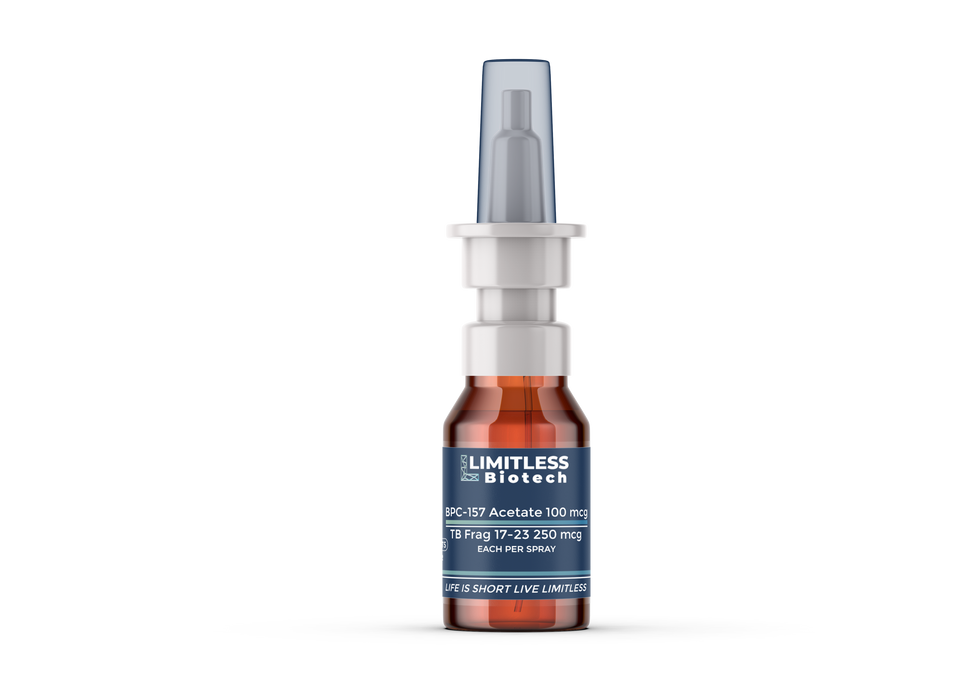
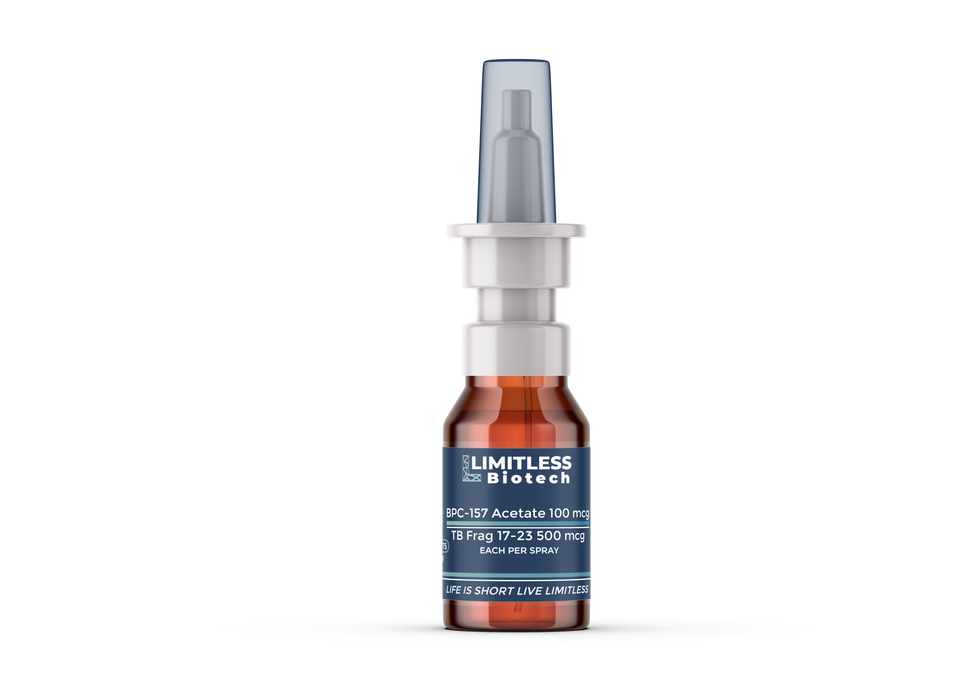
BPC-157 Acetate + TB-500 Fragment 17-23 Blend Spray
✓ Third-party tested by certified labs
✓ Published certificates of analysis
✓ ≥98.5% purity standard
Description
This peptide blend combines BPC 157, a gastric pentadecapeptide, with Thymosin β4 Fragment 17-23 (TB-500) for advanced laboratory research applications. The TB-500 and BPC-157 combination targets wound healing mechanisms through enhanced angiogenesis and cellular migration pathways. Research indicates this peptide blend may accelerate tissue repair processes involving tendon and ligament regeneration. Each solution contains high purity compounds that regulate actin binding and extracellular matrix interactions. Sold for laboratory research purposes only, not human consumption.
Our Product Quality Guarantee
Every Limitless Biotech compound undergoes independent testing for endotoxins and sterility, meeting rigorous research standards through our systematic quality protocols and proactive manufacturing processes.
Buy BPC-157 and TB-500 Peptide Blend From Limitless Biotech
Limitless Biotech provides USA-manufactured BPC-157 and thymosin beta-4 for sale with verified molecular sequences and purity through comprehensive third-party testing. We ensure research quality with same-day shipping and dedicated customer support for your scientific endeavors.
Research
Laboratory studies demonstrate distinct yet complementary mechanisms between BPC-157 and TB-500 Fragment across multiple research areas.
Vascular and Angiogenic Research
BPC-157 activates the Src-Caveolin-1-eNOS signaling pathway, promoting nitric oxide generation in isolated tissue models[1]. The peptide enhances VEGF-A expression and activates ERK1/2 pathways controlling endothelial cell migration[2].
TB-500 Fragment influences endothelial function by upregulating AKT activity and reducing endothelin-1 secretion in laboratory models[3]. Both peptides regulate specialized pro-resolving lipid mediator pathways in cell culture studies[4].
Tissue Repair Mechanisms
BPC-157 enhances growth hormone receptor expression in tendon fibroblast cultures through JAK-2 pathway activation[5]. Laboratory studies show the peptide accelerates granulation tissue formation and promotes collagen deposition in wound models[6].
TB-500 Fragment functions as a G-actin sequestering protein that regulates cytoskeletal dynamics in cell migration studies[7]. Research demonstrates the peptide prevents cell apoptosis and enhances cell proliferation across multiple tissue types[8].
Cellular Signaling Research
BPC-157 activates VEGF-A/VEGFR1-mediated AKT/p38/MAPK signaling while promoting endoplasmic reticulum stress resolution[9]. The peptide demonstrates FAK-paxillin pathway activation that regulates cellular adhesion and migration[10].
TB-500 Fragment modulates thymosin-β4/profilin exchange reactions controlling actin filament formation[11]. Research indicates the peptide influences multiple growth factor pathways including those regulating stem cell differentiation through cellular mechanics[12].
Anti-Inflammatory Properties
Both peptides exhibit anti-inflammatory effects through distinct mechanisms. BPC-157 reduces pro-inflammatory cytokines including TNF-alpha and IL-17 in laboratory inflammation models[13].
TB-500 Fragment inhibits NLRP3 inflammasome activation through NF-κB and JNK/p38 MAPK pathway suppression[14]. Studies show the peptide reduces reactive oxygen species production while inducing autophagy through PI3K/AKT/mTOR modulation[15].
Gastrointestinal Research
Laboratory studies demonstrate BPC-157’s effects on gastrointestinal tract healing and recovery of various tissue connections[16]. The peptide shows cytoprotective effects on epithelial surfaces in cell culture models[17].
Research indicates both peptides work through nitric oxide system interactions to support barrier function restoration in laboratory applications[18].
References
- P. Sikiric et al., “Gastric pentadecapeptide BPC 157 in cytoprotection to resolve major vessel occlusion disturbances, ischemia-reperfusion injury following Pringle maneuver, and Budd-Chiari syndrome,” Baishideng Publishing Group Inc., Jan. 2022. doi: 10.3748/wjg.v28.i1.23. https://doi.org/10.3748/wjg.v28.i1.23
- M.-J. Hsieh et al., “Modulatory effects of BPC 157 on vasomotor tone and the activation of Src-Caveolin-1-endothelial nitric oxide synthase pathway,” Springer Science and Business Media LLC, Oct. 2020. doi: 10.1038/s41598-020-74022-y. https://doi.org/10.1038/s41598-020-74022-y
- L. Su et al., “Thymosin beta-4 improves endothelial function and reparative potency of diabetic endothelial cells differentiated from patient induced pluripotent stem cells,” Springer Science and Business Media LLC, Jan. 2022. doi: 10.1186/s13287-021-02687-x. https://doi.org/10.1186/s13287-021-02687-x
- Y. Wang, L. Banga, A. S. Ebrahim, T. W. Carion, G. Sosne, and E. A. Berger, “Activation of pro-resolving pathways mediate the therapeutic effects of thymosin beta-4 during Pseudomonas aeruginosa-induced keratitis,” Frontiers Media SA, Sep. 2024. doi: 10.3389/fimmu.2024.1458684. https://doi.org/10.3389/fimmu.2024.1458684
- C.-H. Chang, W.-C. Tsai, Y.-H. Hsu, and J.-H. Pang, “Pentadecapeptide BPC 157 Enhances the Growth Hormone Receptor Expression in Tendon Fibroblasts,” MDPI AG, Nov. 2014. doi: 10.3390/molecules191119066. https://doi.org/10.3390/molecules191119066
- S. Seiwerth et al., “Stable Gastric Pentadecapeptide BPC 157 and Wound Healing,” Frontiers Media SA, Jun. 2021. doi: 10.3389/fphar.2021.627533. https://doi.org/10.3389/fphar.2021.627533
- Y.-Y. Wang, Q.-S. Zhu, Y.-W. Wang, and R.-F. Yin, “Thymosin Beta-4 Recombinant Adeno-associated Virus Enhances Human Nucleus Pulposus Cell Proliferation and Reduces Cell Apoptosis and Senescence,” Ovid Technologies (Wolters Kluwer Health), Jun. 2015. doi: 10.4103/0366-6999.157686. https://doi.org/10.4103/0366-6999.157686
- D. C. Morris, Z. G. Zhang, J. Zhang, Y. Xiong, L. Zhang, and M. Chopp, “Treatment of neurological injury with thymosin β4,” Wiley, Oct. 2012. doi: 10.1111/j.1749-6632.2012.06651.x. https://doi.org/10.1111/j.1749-6632.2012.06651.x
- H. Wu et al., “Clopidogrel-Induced Gastric Injury in Rats is Attenuated by Stable Gastric Pentadecapeptide BPC 157,” Informa UK Limited, Dec. 2020. doi: 10.2147/dddt.s284163. https://doi.org/10.2147/dddt.s284163
- [P. Sikiric et al., “Brain-gut Axis and Pentadecapeptide BPC 157: Theoretical and Practical Implications,” Bentham Science Publishers Ltd., Oct. 2016. doi: 10.2174/1570159×13666160502153022. https://doi.org/10.2174/1570159×13666160502153022
- K. Maar, J. E. Thatcher, E. Karpov, S. Rendeki, F. Gallyas, and I. Bock-Marquette, “Thymosin Beta-4 Modulates Cardiac Remodeling by Regulating ROCK1 Expression in Adult Mammals,” MDPI AG, Apr. 2025. doi: 10.3390/ijms26094131. https://doi.org/10.3390/ijms26094131
- M. C. Sanders, A. L. Goldstein, and Y. L. Wang, “Thymosin beta 4 (Fx peptide) is a potent regulator of actin polymerization in living cells.,” Proceedings of the National Academy of Sciences, May 1992. doi: 10.1073/pnas.89.10.4678. https://doi.org/10.1073/pnas.89.10.4678
- F. Amic et al., “Bypassing major venous occlusion and duodenal lesions in rats, and therapy with the stable gastric pentadecapeptide BPC 157, L-NAME and L-arginine,” Baishideng Publishing Group Inc., Dec. 2018. doi: 10.3748/wjg.v24.i47.5366. https://doi.org/10.3748/wjg.v24.i47.5366
- J. Choi et al., “Thymosin Beta 4 Inhibits LPS and ATP-Induced Hepatic Stellate Cells via the Regulation of Multiple Signaling Pathways,” MDPI AG, Feb. 2023. doi: 10.3390/ijms24043439. https://doi.org/10.3390/ijms24043439
- H. Demirtaş, A. Özer, A. K. Yıldırım, A. D. Dursun, Ş. C. Sezen, and M. Arslan, “Protective Effects of BPC 157 on Liver, Kidney, and Lung Distant Organ Damage in Rats with Experimental Lower-Extremity Ischemia–Reperfusion Injury,” MDPI AG, Feb. 2025. doi: 10.3390/medicina61020291. https://doi.org/10.3390/medicina61020291
- L. Kalogjera et al., “Stomach perforation-induced general occlusion/occlusion-like syndrome and stable gastric pentadecapeptide BPC 157 therapy effect,” Baishideng Publishing Group Inc., Jul. 2023. doi: 10.3748/wjg.v29.i27.4289. https://doi.org/10.3748/wjg.v29.i27.4289
- N. Lojo et al., “Effects of Diclofenac, L-NAME, L-Arginine, and Pentadecapeptide BPC 157 on Gastrointestinal, Liver, and Brain Lesions, Failed Anastomosis, and Intestinal Adaptation Deterioration in 24 Hour-Short-Bowel Rats,” Public Library of Science (PLoS), Sep. 2016. doi: 10.1371/journal.pone.0162590. https://doi.org/10.1371/journal.pone.0162590
- Z. Djakovic et al., “Esophagogastric anastomosis in rats: Improved healing by BPC 157 and L-arginine, aggravated by L-NAME,” Baishideng Publishing Group Inc., 2016. doi: 10.3748/wjg.v22.i41.9127. https://doi.org/10.3748/wjg.v22.i41.9127
Specification
| Specification | Details |
|---|---|
| BPC-157 Sequence | Gly-Glu-Pro-Pro-Pro-Gly-Lys-Pro-Ala-Asp-Asp-Ala-Gly-Leu-Val |
| TB4 Fragment 17-23 Sequence | Leu-Lys-Lys-Thr-Glu-Thr-Gln |
| BPC-157 Molecular Formula | C62H98N16O22 |
| TB4 Fragment 17-23 Molecular Formula | C36H66N10O13 |
| BPC-157 Molecular Weight | 1419.56 g/mol |
| TB4 Fragment 17-23 Molecular Weight | 846.97 g/mol |
| BPC-157 CAS Number | 137525-51-0 |
| TB4 Fragment 17-23 CAS Number | 476014-70-7 |
| BPC-157 PubChem CID | 9941957 |
| TB4 Fragment 17-23 PubChem CID | 10169788 |
| Synonyms | BPC-157: Bepecin, PL 14736, Body Protection Compound 157, GEPPPGKPADDAGLV TB4 Fragment 17-23: TB-500 Fragment (17-23), Fequesetide, LKKTETQ |
| Purity | ≥99% (HPLC) |
| Storage Conditions | Store away from heat and moisture |
| Shelf Life | 36 months from date of manufacture when stored properly |
| Quality Verification | Third-party tested by certified laboratory |
| Manufacturing Standard | USA-made, pharmaceutical-grade, GMP compliant |
| Intended Application | In vitro research applications only |